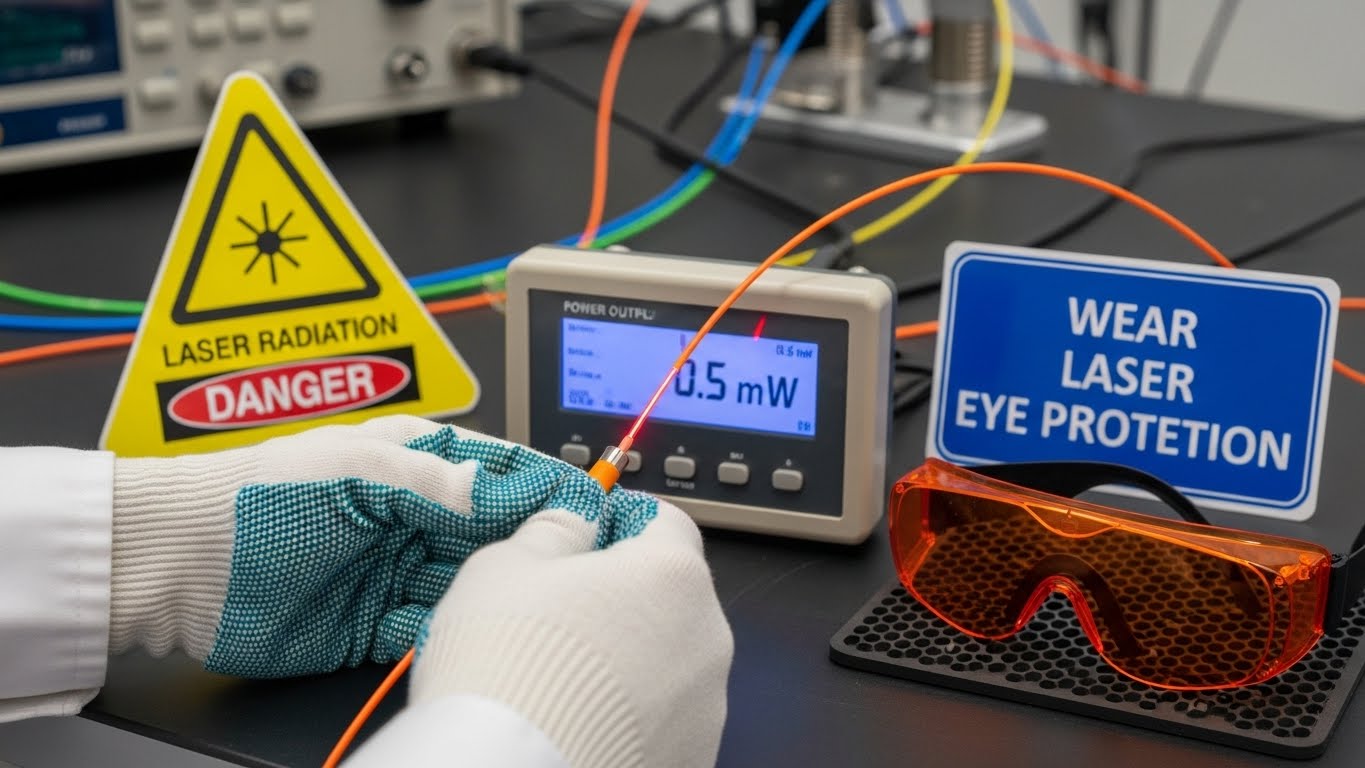
High Data traffic over long distances needs huge power in optical networks. But higher optical power leads to a riskier environment for both instruments and humans. If you are responsible for or work on installing these systems, it’s critical to understand Automatic Power Reduction (APR).
It’s about more than just the fact that it is a feature; this is an important safety feature that can save you from hurting yourself or destroying your equipment in high-power setups.
Understanding Automatic Power Reduction (APR)
APR is the “airbag” of your optical network. Output Levels In a high power system, i.e., EDFA, output levels can be somewhat higher (+20dBm to +27dBm). That’s enough intensity to instantly burn a technician’s retina or vaporize materials.
Apr works by listening to the line for particular sounds. Once it senses a “Loss of Signal” (LOS) or an abrupt fall in return loss, the signal can have been interrupted either by a cut in the cable or an unplugged connector – actuation occurs instantaneously. The APR circuit lowers the output power to a safe level (usually < +10dbm) in milliseconds or completely cuts off. This quick response is required in order for high-power devices to comply with safety standards (i.e., IEC 60825-1).
The Fiber Fuse Effect and APR
One of the most destructive phenomena in fiber optics is the “Fiber Fuse” effect. This occurs when a local heat source, such as a dirty connector or a tight bend, absorbs enough optical energy to generate a plasma discharge. This discharge can travel backward along the fiber toward the laser source, physically destroying the fiber core in its path.
Research indicates that the threshold power for initiating this propagation in standard single-mode fibers is approximately 1.39 W at 1550 nm. Without APR, a simple, dirty connector could trigger a chain reaction that ruins kilometers of cabling. APR prevents this by cutting the power before the thermal runaway can sustain the plasma propagation.
The “Fiber Fuse” effect is among the most damaging effects in fiber optics. This happens when some localized heat source, for example, a dirty connector or tight bend, has absorbed enough optical energy to initiate a plasma discharge. This discharge can propagate in the reverse direction along the fiber towards the laser source, burning its way through the fiber body.
It has been shown that the threshold power required to launch this nonlinear propagation in conventional telecommunications-grade single-mode fibers is about 1.39 W at 1550 nm. APR’s absence would mean that a badly stripped connector could accelerate a chain reaction that would destroy kilometers of cabling. APR inhibits it by suppressing the power supply before a propagating plasma can be maintained by the thermal runaway.
Technical Specifications and Compliance
To prevent accidental damage, optical amplifiers are rated according to their output power. High-power EDFAs are typically Class 3B or Class 4 lasers.
- Class 3B: Causes a hazard to the eye if exposed directly.
- Class 4: Causes eye and skin irritation; fire hazard possible.
They need to comply with the international laser safety standard IEC 60825-1 to be sold and used legally in N.A. or Europe, etc. This standard, in effect, requires an automatic shutdown/reduction feature to be included in laser classes. When procuring equipment, confirm that the hardware is CE and RoHS certified so it meets these strict safety standards.
Impact on Network Performance
The question inevitably arises whether these built-in safety functions throttle performance. It should be noted that APR does not cause latency. The detection circuit runs parallel with the data path and does not affect the normal operations of the data to prevent any influence on data integrity.
Furthermore, APR systems are intelligent. After being triggered, they don’t remain off forever. The system goes into a “probing mode,” emitting a weak pulse every now and then. The system ramps up the power until it can find the probe, and once detected, it ramps down to restore the network without manual intervention.
The Role of EDFAs in Modern Optical Communication
EDFAs are the “powerhouse” amplifiers used to boost signals within C-band and L-band. Semiconductor Optical Amplifiers (SOAs) are rapidly developing as well. New generations of quantum well and quantum dot materials have drastically enhanced the SOA performance capabilities for providing larger gain bandwidths and lower noise figure values.
1 Through the conceptual levels physical level depends on these amplifiers, and the logical layer is based on smart traffic management. This is how the Application Control Engine makes its entrance. An Application Control Engine (ACE) ensures optimal application delivery with load balancing, SSL offloading, and content switching at both Layers 4 and 7. With efficient high-power amplification and intelligent application control, network operators are able to guarantee both high speed and stability.
Data and Statistics
The following table highlights key performance metrics for modern high-power SOAs, demonstrating the capabilities that require robust safety management.
| Metric | Reported Value | Significance |
| Maximum Saturation Output | > 34.7 dBm | Indicates high power handling capable of long-haul transmission. |
| Maximum Gain | > 21 dB | High signal amplification strength. |
| Lowest Noise Figure | < 4 dB | Ensures signal clarity and reduces error rates. |
| 3 dB Gain Bandwidth | > 120 nm | Allows for broad wavelength division multiplexing (WDM). |
| Polarization-Dependent Gain | 0.1 dB | Shows stability across different signal polarizations. |
Conclusion
With the cutting-edge revolutions in optical networking the power levels in fiber infra- structure will be higher than ever before. APR is not a regulatory hoop to jump through; it’s the single element that will keep your technicians from harm and your infrastructure safe from fiber fuse explosion. By selecting equipment that is in compliance with all of these guidelines and by having a basic understanding of how these safety features work, you can continue to maintain a successful and safe network.