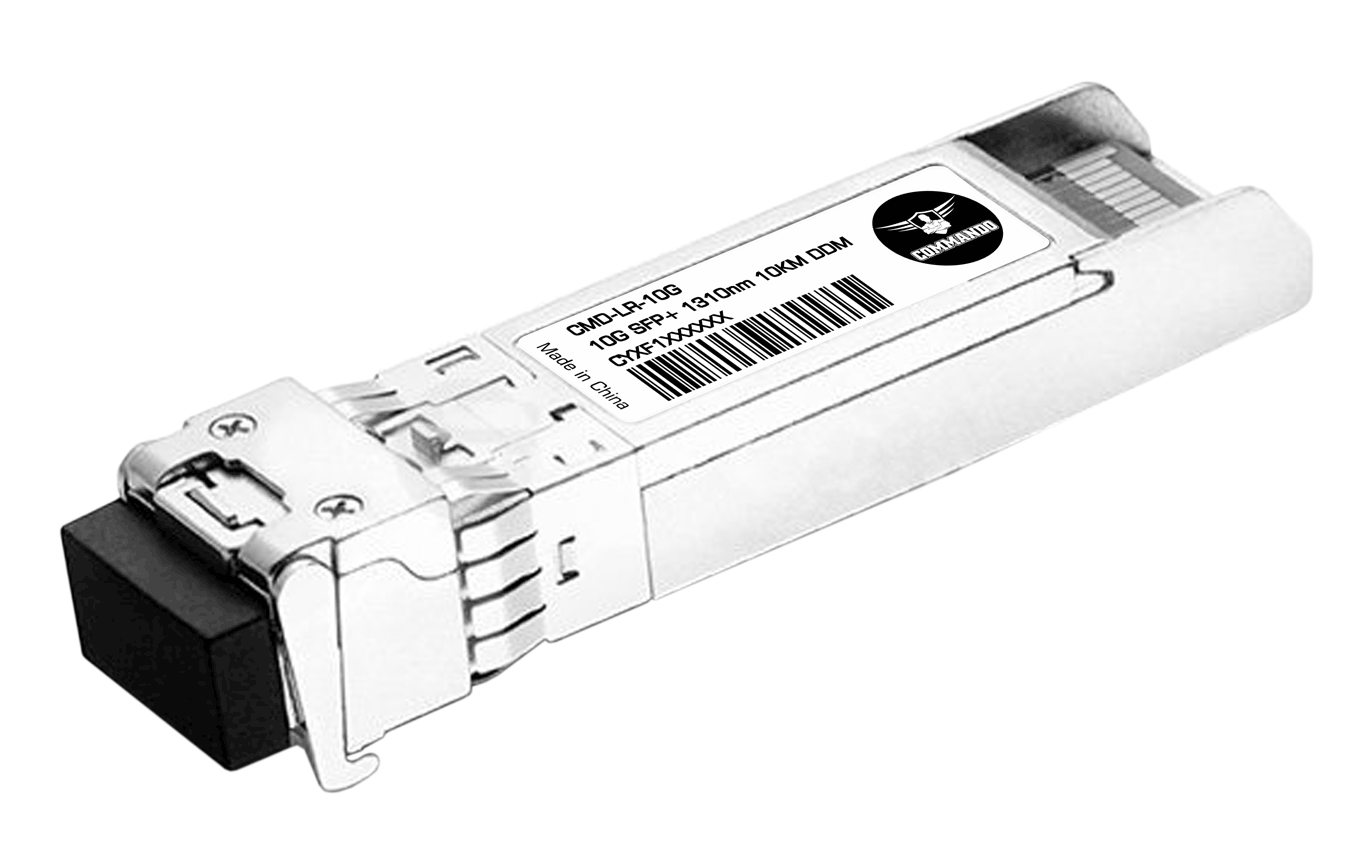
What 10GBASE-LR Really Does
10GBASE-LR might not sound exciting in today’s multi-gigabit world, but it continues to be one of the most reliable transceiver standards around. Running over single-mode fiber at a 1310 nm wavelength, it pushes data at 10 Gbps over distances of up to 10 km. That’s plenty of reach for data centers, enterprise networks, or even regional service providers.
The “LR” stands for “Long Reach,” and it lives up to the name. The modules maintain stable transmission over long spans, with low latency and minimal jitter. They’re the quiet workhorses that link everything together — between racks, across buildings, or from one side of a campus to another. You don’t notice them because they just keep running.
Reliability Built Into the Design
What keeps 10GBASE-LR relevant is reliability. These modules are built on a decade of refinement. The DFB laser transmitter and PIN photodiode receiver have proven themselves in every kind of environment — from temperature-controlled data centers to outdoor enclosures. They can tolerate minor imperfections in fiber runs or slight connector wear without failing.
Power consumption is another strength. Most 10GBASE-LR optics use under 1 watt, which means less heat and fewer cooling costs. For dense deployments with hundreds of modules, that difference adds up quickly. It’s one reason operators still favor 10G optics for access or aggregation layers.
How 10GBASE-LR Fits in Today’s Networks
Data centers today aren’t uniform. Some racks run 100G, others 25G, and many still rely on 10G for various links. The 10GBASE-LR sits comfortably in that mix. It’s perfect for secondary connections or for linking devices that don’t need extreme bandwidth but must stay online all the time.
It’s also widely used in backup networks, out-of-band management, and disaster recovery links. These systems don’t carry massive traffic, but they’re crucial when something goes wrong. A simple, dependable 10GBASE-LR module keeps them running without fuss.
In campus environments, it’s the go-to for connecting buildings or floors through existing single-mode fiber. You don’t need to rewire or re-engineer anything — just plug in and go. And because it’s an IEEE standard, it’s compatible across almost every major vendor.
Why It’s Still Worth Using
Even though faster modules are now mainstream, 10GBASE-LR has something that newer optics don’t always deliver: stability. It’s a known quantity — engineers trust it. It doesn’t surprise you with firmware updates, heat issues, or interoperability quirks.
For small and mid-size businesses, it’s also more than enough. Not every workload needs 25G or 40G. Email servers, databases, file storage, VoIP — 10G handles all that easily. And since it’s cheap, organizations can build redundant links without blowing their budgets.
A Reliable Bridge Between Generations
10GBASE-LR also plays an important transitional role. Networks moving from 1G to 25G often pass through a 10G phase. It’s the step that lets you modernize gradually — upgrade one layer at a time without breaking compatibility. Even newer 25G modules often share similar physical structures, making the shift smoother when the time comes.
Vendors like QSFPTEK have continued to refine their 10G modules to maintain top-level compatibility with Cisco, Arista, Juniper, and Dell systems. That cross-vendor support helps businesses avoid vendor lock-in and reduces maintenance complexity.
The Bigger Picture
You might think of 10GBASE-LR as an aging technology, but it’s actually a foundation. The entire modern Ethernet ecosystem was built on these 10G standards. They set the groundwork for how data moves efficiently across long distances using optical transmission. Even as speeds rise, the reliability lessons from 10G still define the design philosophy behind new generations.
Conclusion
10GBASE-LR optical transceivers continue to hold their ground in an era dominated by higher speeds. They’re simple, solid, and surprisingly efficient. Their long reach, low cost, and proven stability make them indispensable in real-world deployments. Whether as a backbone, a bridge, or a backup link, 10GBASE-LR remains one of the most trusted optical modules in use — a reminder that sometimes the simplest tools are the ones that last the longest.